
Enhancing women’s participation in urban last-mile logistics
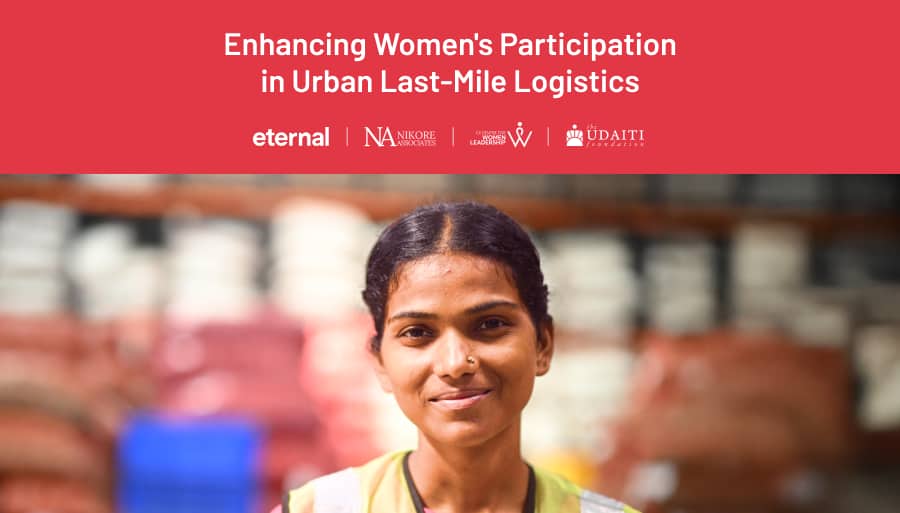
Who powers India’s logistics growth?
India’s logistics growth story is often told through numbers - billions in market value, millions of livelihoods, and notable growth in quick commerce and food delivery.
But behind this growth lies a powerful question: who gets to participate?
The white paper titled “Enhancing Women’s Participation in Urban Last-Mile Logistics”, is authored by Nikore Associates, The Udaiti Foundation and the Confederation of Indian Industry - Centre for Women’s Leadership (CII-CWL), with inputs from Eternal’s platforms - Zomato and Blinkit. It examines how one of India’s growth engines can also offer livelihood opportunities for women, at scale.1
The white paper examines women’s participation in urban last-mile logistics as an economic opportunity - one aligned with India’s growth ambitions and the vision of Viksit Bharat 2047.
A rapidly expanding sector - with low women’s participation
Urban last-mile logistics offers opportunities across warehousing, micro-fulfillment centres, quick commerce and food delivery. It has emerged as one of the most dynamic segments of India’s urban economy.
The sector is expected to generate over 10 million new livelihood opportunities by 2027.2 Yet women’s participation across these roles currently remains between 1 - 5 percent.3 If women were to access even 10 percent of upcoming opportunities, nearly 1 million additional livelihoods could be unlocked by 2027.4 The scale of the opportunity is clear - the question is how to unlock it.
Why urban last-mile logistics holds significant potential for women’s workforce participation
Urban last-mile logistics is particularly relevant as an entry point for women because of:
- Flexible or shift-based participation
- Hyperlocal work opportunities
- Limited formal qualification requirements
- Short training cycles with on-the-job learning
- Competitive earning potential
For example, delivery partners can opt for time slots and select preferred work areas within a city, enabling hyperlocal engagement. The continued expansion of micro-fulfillment centres further strengthens access to close-to-home opportunities.
These features make the sector especially relevant for first-time workers, women returning to the workforce and those balancing paid work with caregiving responsibilities.
However, the white paper emphasizes that opportunity alone does not guarantee participation. Ecosystem-level constraints across a woman’s journey through the workforce must be addressed, with intention.
A stage-wise framework for action
A critical contribution of the white paper is its three-stage framework which recognizes that barriers arise at different stages in a woman’s journey into and within the workforce.
Rather than treating inclusion as a single intervention, the framework identifies coordinated actions across three stages:
- Before she enters the workforce: creating an enabling environment
- When she seeks work: preparation for entry into the workforce
- While she is working: enhancing retention of women in the workforce
Each stage requires distinct but interconnected ecosystem responses.
Stage 1: Before she enters the workforce
Norms, awareness and regulatory clarity Social norms remain a foundational constraint for most women to participate in roles in urban last-mile logistics. Evidence shows that 84% of women in urban low-income households require their family’s permission to work, regardless of the type of work.5
Roles such as ‘delivery partner’ or ‘warehouse worker’ are often perceived as male-dominated, limiting awareness that women can take up these roles.
To address this, the white paper proposes national and state-level awareness campaigns featuring women in logistics roles, awareness modules in schools and vocational institutions and the use of platforms such as SANKALP Hubs to disseminate information of livelihood opportunities in the logistics sector.
In parallel, regulatory clarity is essential. The report calls for uniform guidelines on night-time work for women in the logistics sector.
Stage 2: When she seeks work
Skilling, digital readiness and asset access At the point of entry, skill and asset gaps become more visible.
To address these gaps, the white paper recommends adding logistics-focused courses to national skilling programs. These programs should include basic digital literacy and two-wheeler riding training. Confidence-building and soft skills should be built into these programs to better prepare women for entry into the sector.
Skilling, however, must be complemented by facilitating access to, and ownership of assets. Delivery roles typically require a smartphone and access to a two-wheeler. Women are less likely to own or independently purchase such assets due to limited access to credit.6 7
The white paper proposes government-backed credit guarantee mechanisms to enable financing for smartphones and two-wheelers, innovative financing models and alternative credit assessment approaches.
The report notes that even access to a smartphone increases women’s likelihood of engaging in economic activity, particularly in gig work opportunities.
Stage 3: While she is working
Infrastructure, childcare and safety
Participation only scales when women are able to remain in the sector over time. The white paper underscores that retention depends not just on the nature of the role, but also on the broader urban ecosystem.
Access to sanitation facilities that are clean and safe play a foundational role. The availability of public toilets and rest areas that are visible on navigation maps directly influences how long women can remain in roles requiring travel by road. Leveraging existing urban missions to expand public infrastructure is recommended.
Access to childcare is another decisive factor. Expanding coverage under the Palna scheme and situating crèches near warehouses could help reduce attrition among working mothers with young children.
Gender-responsive safety systems are equally critical. Safe public transport connectivity, improved street lighting and standardized distress-response mechanisms all contribute to building confidence in women workers.
The white paper emphasizes that visible and responsive infrastructure and safety systems are central - not peripheral - to sustaining women’s participation at scale.
A coordinated model for scale
A recurring theme across the white paper is coordination.
Unlocking women’s participation in urban last-mile logistics requires alignment across central ministries, state governments, urban local bodies and the private sector.
Central ministries can establish national standards for skilling, accountability frameworks and financing mechanisms. State governments can adapt and implement policies in local contexts. Urban local bodies play a critical role in building and maintaining infrastructure. Private sector platforms and logistics firms can align skilling, onboarding and operational practices.
The white paper positions urban last-mile logistics not just as a sectoral growth story but as a systems opportunity, where economic expansion and women’s participation can reinforce each other.
From growth to inclusion
India’s logistics expansion is well underway.
The white paper suggests that it can become a scalable pathway for women’s economic participation, provided ecosystem-level constraints are addressed intentionally and collectively.
The urban last-mile logistics sector offers scale, flexibility and accessibility. With aligned policy, infrastructure and industry action, the sector can become a force for inclusion.
Read the full white paper here.
References: 1 Press Information Bureau, Government of India. Logistics: India’s growth engine. Aug. 2025.
5 Detailed Findings from Our Urban Research.” FSG, Nov. 2022