
Let's make room for more people
A restaurant has always been more than just a place to eat. It is where people actively choose to be present. It is where first dates happen, solo diners find comfort in the collective hum of a crowd, and families and friends reconnect over spontaneous or planned catchups, as conversations easily outlast the meal itself.
From a restauranteur’s perspective, a dining out experience has never really been just about serving customers the food they order. It has been about creating experiences where people feel inspired yet comfortable enough to belong.The next big opportunity for restaurants lies in expanding that feeling of belonging to more people than ever before.
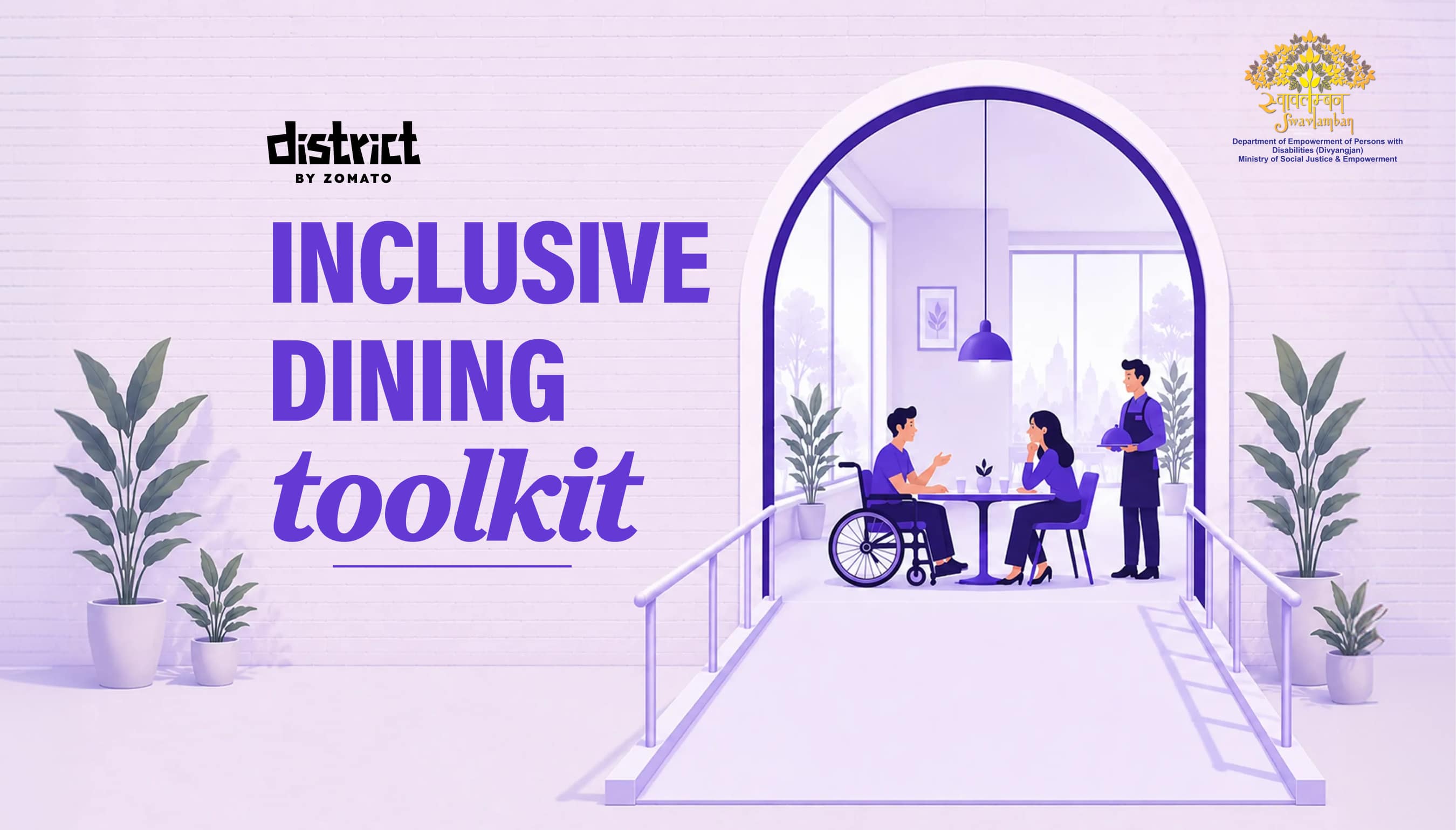
That belief is what led us to create the Inclusive Dining Toolkit, in collaboration with the Department of Empowerment of Persons with Disabilities along with Samarthyam, and The Association of People with Disability.
India is home to over 2.68 crore persons with disabilities, alongside millions of senior citizens and people with temporary mobility, sensory or cognitive challenges, yet accessibility information across restaurants remains inconsistent or entirely absent.
At District, we have been working on making it easier for people to discover and book tables at restaurants that have screen reader friendly menus, are wheelchair-accessible, have elevator access, and more. We have also introduced a feature that allows customers to ask questions or make special accessibility related requests at the time of booking.
Along our journey, we realized that many of our restaurant partners, while keen to create accessible experiences, were not equipped with the knowledge of what they could do about it.
The Inclusive Dining Toolkit includes practical initiatives to help restaurants shape their dining experiences to be more welcoming and comfortable for people with disabilities, senior citizens, parents with strollers, pregnant women and even someone temporarily recovering from an injury.
Inside the toolkit, we talk about practical steps restaurants can take across the entire guest journey, including:
- Highlight parking and seating layouts online
- Offer screen reader friendly digital menus
- Ensuring restaurant contact numbers are responsive
- Creating seating layouts that allow wheelchair and stroller movement
- Using clearer signage, non-slip flooring, softer lighting and quieter seating zones
- Training staff to assist guests with confidence and care
One of my favourite sections in the toolkit talks about something called the 'Eye-Level Check.' Sit down in a chair and look around the restaurant from a seated perspective. Can you clearly see signages? It sounds simple, but perspective changes design.
The same applies to menus. A beautiful leather-bound menu may look premium, but it may also be difficult for someone with arthritis or muscular dystrophy to hold comfortably. QR codes linked to inaccessible images may not work with screen readers. Menus can be made screen reader friendly by being text-based or using QR codes that are linked to accessible PDFs.
Accessibility often lives inside these quieter details.
At Eternal, we have a range of inclusivity initiatives that have been woven across business operations, people and partners. We are committed to using our learnings from our existing initiatives to create an inclusive ecosystem for all.
A restaurant that feels easier to access becomes easier to recommend. Easier to revisit. Definitely more trusted. We hope that the step we’re taking by launching this toolkit for the restaurant community enables you to take bigger leaps necessary for an inclusive India.
Read and download the Inclusive Dining Toolkit, here. For the accessible version of the toolkit, click here.
In case of any questions or to share your feedback, please write to** impact@district.in**